

By Patricia Bradford | November 24, 2025
CHAMPAIGN — Deep End, the newest exhibition at the University YMCA’s Murphy Gallery, is a study of all that water can hold. In artist Jameel Bridgewater’s hands, water becomes a place of possibility and fear, safety and danger, memory and erasure.
Moving through the installation, visitors are welcomed into a space where generations meet. With a blend of film, photographs, tile-based sculptures, and archival pieces, Bridgewater traces both his family’s relationship to swimming and the long history of those who get to be in the water, and those who have been kept out.
So much of the exhibition circles back to Bridgewater’s grandmother, who, he said, saw swimming as “a form of liberation.” That belief is demonstrated throughout every piece in the room.
According to Bridgewater, “There were two things that made her feel free: cutting her hair and wearing it natural, and number two was learning how to swim.”
A close up of a shadow figure on a beachfront with other figures out in the ocean; a stone frame holds the picture in place on a gallery wall.
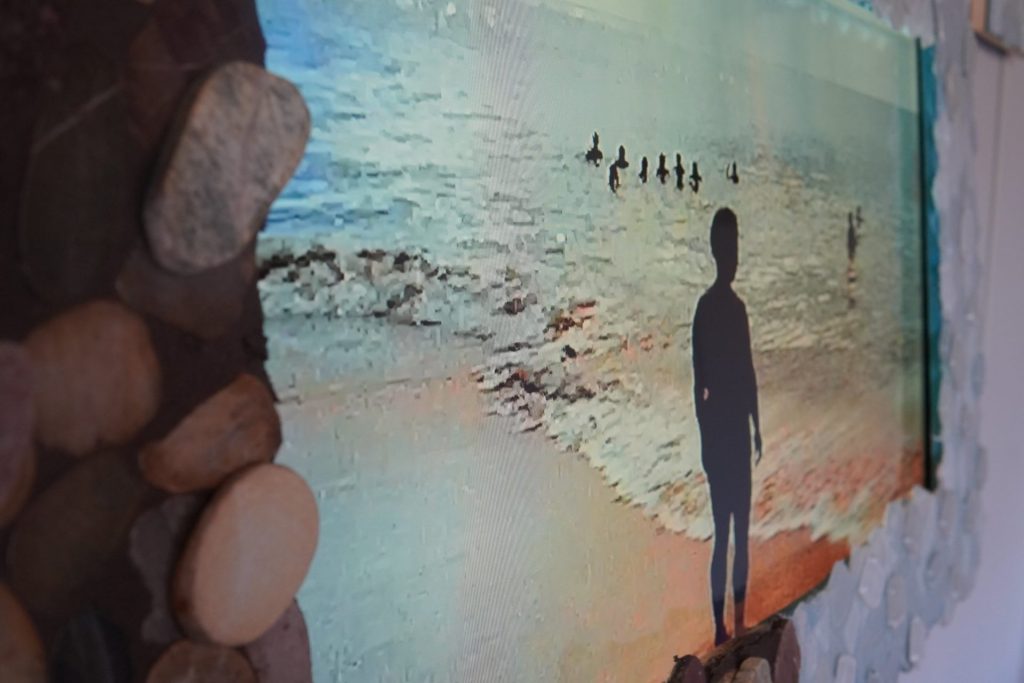
At the gallery entrance sits Estuary, a 9-minute film that features clips of Bridgewater’s grandmother gliding through the water with an ease that feels both carefree and meticulous.
Half the screen is framed by rugged stone, and the other is ringed in pool tiles that gleam like ice. Standing before it feels like standing at the edge of two shores at once.
To the left, Retour aux Goree looks across the Atlantic—a photograph of his grandmother in Senegal, bordered in the same rough stone. To the right, Lessons, a 33mm photograph of Bridgewater’s cousin at Sholem pool, glows inside a frame of pool blue and clear tile.
Together, the three works form a small constellation—family across place, time, and water.
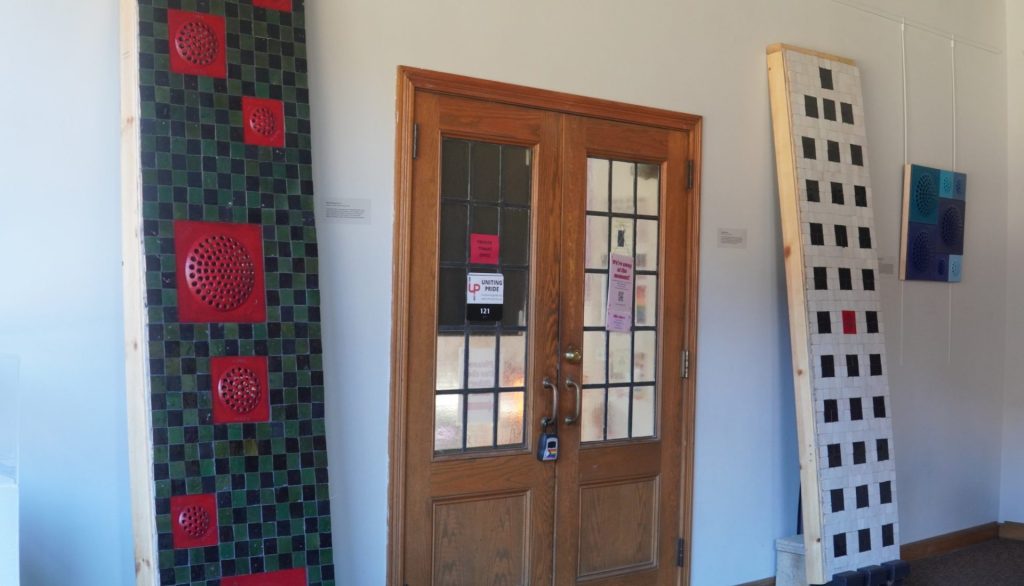
Across the gallery, Crossing in Red meets you with a truth that even some textbooks refuse to write. This piece becomes a point of reflection, both literally and structurally, drawing viewers into the center of a history that is usually held at a distance. It’s the way the red cuts through the cool ceramic that stops you.
Crossing in Red doesn’t reenact history. It places the viewers inside, asking them to feel the nearness of what is often told to be forgotten. You’re now in the deep end.
A few feet away, Atlantic Between Us shifts the conversation from presence to absence. The Green ceramic tiles stretch across the wall, with red drains that interrupt the grid-like warnings at night. The work references the drained pools of segregated America.
According to Bridgewater, it’s a piece that embodies the show, capturing the violence of exclusion and the faint history that lingers beneath it. Without water, the piece becomes its own evidence: a mirror of society, and where each viewer falls in its reflection.
Not far from it, Indigo South Carolina turns the gallery towards labor, specifically the labor that made the color blue possible. The surface is rich, almost lush, but the work and history beneath is anything but. The work pays tribute to the enslaved African Americans along the South Carolina coast, whose brutal work extracting indigo pigment underpinned an entire economy.
Bridgwater approaches each piece with the eye of a historian, revealing at heart the beauty produced and the violence required to produce it.
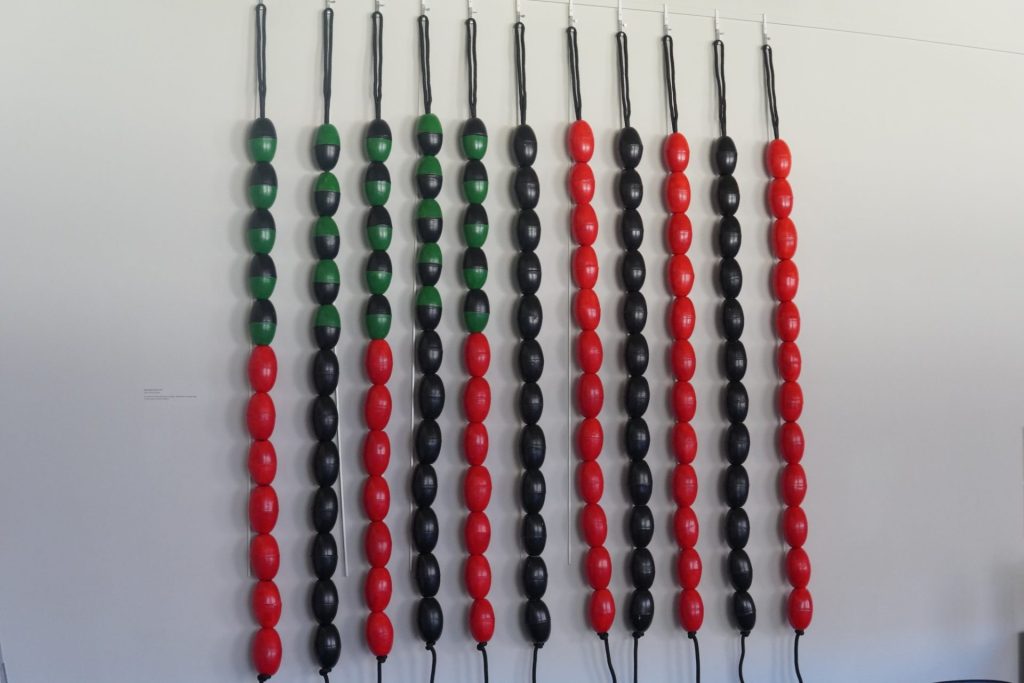
Black and green, and red pool buoys are threaded as an art exhibit hanging on a white gallery wall.
On the opposite wall, Reparations Pool 2025 pulls viewers in with its stark yet bold presence. A line of red, green, and black buoys stretches across the wall — a nod to David Hammons’ reimagined African American flag. Paired with Bridgewater’s pointed phrase “to line a pool, or to line a check,” the work expands beyond its simple materials.
The buoys begin to read like a ledger, a boundary, a question about value and access. What looks orderly at first becomes charged, inviting viewers to stand inside the tension between what was promised and what was paid.
Talking with Bridgewater during the opening reception, there’s an ease to the conversation that mirrors the show itself. Within ten minutes, it feels like catching up with someone you’ve known much longer. He spoke openly about his grandmother’s passing and selling their family home while away at college, and how that loss pushed him deeper into family archives.
“I try to look more intimately so I can really hold the history and information,” he said. The exhibition feels shaped by that intimacy and by the desire not just to remember, but to keep memories alive through presence and form.
Several pieces of photos of swimmers and images of pool pieces and a bright red, yellow, and black Mondrian-like card are all housed in an art gallery exhibit.
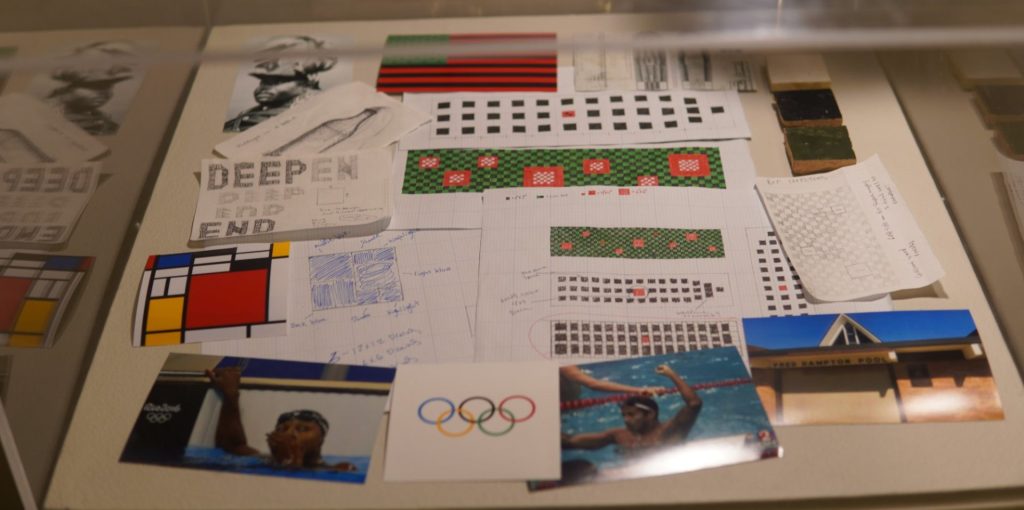
When asked what he hopes visitors feel when they move through the exhibition, Bridgewater said he hopes they leave “liberated and also angry.” Anger, he explained, can create the endurance needed to shift something in everyday life, even something as simple as deciding to learn how to swim.
Deep End ultimately asks viewers to consider water as more than a physical space. It invites reflection on what water has carried — families, journeys, wounds, joy, and the stories that survived against the odds. Bridgewater offers a deeply personal exhibition, but one expansive enough for anyone to find themselves within it.
View the published article on the Smile Politely website / Bridgewater goes Beneath the Surface at the University YMCA